Showing posts with label African Animals. Show all posts

Friday, April 29, 2011

Lake Nakuru

Our weekend trip to Serena Mountain Lodge just teased our appetite for wildlife. So on our final weekend in Kenya we squeezed in another quick trip to the wildlife park at Lake Nakuru. We arranged to travel on Friday evening, have a tour of the park on Saturday morning, and return to Tumutumu Saturday night. We traveled with Kris and Lucy, a couple of British medical students also working at Tumutumu Hospital.
Typical matatu and patrons

Our objective: see amazing animals as quickly and cheaply as possible. Per Google Maps Nakuru is approximately a 2.5 hour drive from Karatina. We priced hiring a car and driver and instead decided to engage the most common method of public transportation: a matatu. Matatus are 14 passenger vans that travel between communities at a nominal rate. They are notorious for being over crowded and their drivers are notoriously aggressive and reckless. When debating whether or not to travel by matatu Matthew often said “More people die in Kenya every year from vehicular accidents than die from malaria”.

Rooster in Matatu

We were determinied not to visit the ATM machine during the trip and only use the shillings in hand. We through caution to the wind and decided to travel by matatu.

The trip to Lake Nakuru took 6 hours on 3 different matatus. Highlights of our journey included a passenger carrying a rooster in her lap (quickly revealed by sound and smell), an hour delay in Nyeri as we waited for our van to fill, and a deteriorating highway riddled with potholes. The highway itself was so poor I'm not sure what difference a private car would have made... I'm certain the asphalt was poured without the proper gravel subgrade. It was an exhausting journey.

When we arrived in Nakuru we checked into our hotel and we had a nice dinner at a Chinese restaurant. It was a lovely and welcome meal – good food and good company. At 6:30 the next morning our tour guide met us at the hotel with an open top van. We were oogling at the animals of the park by 7:30.

And then it was all worth it! Lake Nakuru is well known for the variety of birds it attracts, most famously, pink flamingos. But in addition to spectacular birds we saw loads of baboons, zebras, giraffs, hyenias, rhinosorases, cape buffalo, warthogs, empalas and antilopes. We saw them laze about, get in fights, feed each other and play with each other. All quite close from the safety of our open top van. The only regret is that the lions and the lepords, which are present in the park, did not make an appearance.


White Pelicans


We stopped for a snack break at an overlook at 'Baboon Hill'. We climbed out of the van with our packed lunch and before we knew it a baboon had snuck up and stolen our bread and biscuts! So much for sandwiches! Obviously we were not the first victims... they had practiced well and are known for stealing bananas and other goodies right out of the hands of distracted tourist


Matthew and I with Kris and Lucy at Baboon Hill.


The animals were fantastic and such a wonder. It is easy to see how they are personified in in 'The Lion King'... they each have such distinct character and habits.

Our return matatu trip only took 5 hours. This journey featured a sick passenger, vomiting out the window adjacent to Matthew. We were also seated on the back row and which meant little leg room with the wheel well and spare tire under our feet. The trials of being jostled around the back of a matatu was enough to make us admit our age and that we just weren't interested in this type of travel in the future... the extra expense would be worth the comfort of a safe journey.

Monday, April 18, 2011

Nature Walk at the Mountain Lodge

On Saturday afternoon while at the lodge we went on a nature walk.  A guided tour through the very forest from which all the animals lived and traveled before gathering at the watering hole.  Does that seem a bit crazy?  Don't worry, no need to fear, an escort would follow with an assault rifle in case danger finds us.

We were scheduled to take the hike in the morning but it was delayed because the guard was unavailable.  He had be called away to free an elephant from a snare.  A snare is a trap set by poachers in the forest.  Illegal poaching for the ivory of elephant tusks is a big problem in the park and the enforcement officers are thinnly spread across the large area.

Our guide gave us lots of interesting educational facts about plants and animals and I'd like to share those that stuck with us.


Elephants are long lived in very close-knit familial groups.  They can live up to 70 years and eat as much as 200 kilos of foliage a day.  They feed 16 hours of each day.  By way of a poor digestive system they are responsible for sewing many of the seed of the forest in their depositions.  What I found really interesting about these tremendous creatures:  they mourn the loss of a family member and will actually gather debris to cover, or bury, their loved one.

Those cape buffalo are an irritable species.  They travel in groups and their aggression prevents them from being domesticated.  A lone male cape buffalo is one of the most dangerous animals to run into in the forest, they will attack unprovoked.  If you are so unlucky your only hope is to climb a tree.  If none is near, lie flat on the ground.  Hopefully he will just turn you over several times with his horns and stomp on you.  This is the only way people have survived a meeting.

The difference between the forest and the bush is that the bush has been deforested.  This is a huge problem in Kenya where many people gather wood for building fences and fire.  The old growth rainforest that we walked through has a beautiful clear, low understory.  By comparison the bush is thick and dense with woody shrubs.  It will take 600 years to return to a mature forest.

And I have to mention the Strangling Ficus.  This is a close relative of the beautiful banya trees we found in Hawaii.  But in this species seedlings find life in the crook of existing trees.  Then the roots form around the existing trees, using it as a crutch to reach the light quicker.  Eventually they completely devour the first tree and strangle it.  I think this is the same ficus you find consuming the temples of Angkor What in Cambodia.


Kenya is named for Mount Kenya, the country's second highest peak at 17000 ft.  (Mt. Kilamonjaro, south of Nairobi, is taller).  Mt. Kenya was an anomoly to the early western visitors because it sits nearly on the equator (off by 11 miles) and still retains snow and ice on its peak year round.  The name is derived from this contrast of black rock and white ice which many local tribes (each in their own language) called “ostretich tail”, which also has the same contrast.  The tribal word for this, per whichever of the eastern tribes the westerners were near, was something similar to Kenya.  42 distinct and seperate tribes, each with their own language and culture, lived in the boundries of present day Kenya.  Instead of choosing the name of one tribe to identify the region they chose the one landmark they all identify with, Mt. Kenya.

The hike concluded with tea time in the bush.  We came around the corner of the trail to find they had set out cups and saucers.  We sat on a log and enjoyed our afternoon tea.  I found it rather charming and picturesque.  Quite a fine hike.


Serena Mountain Lodge

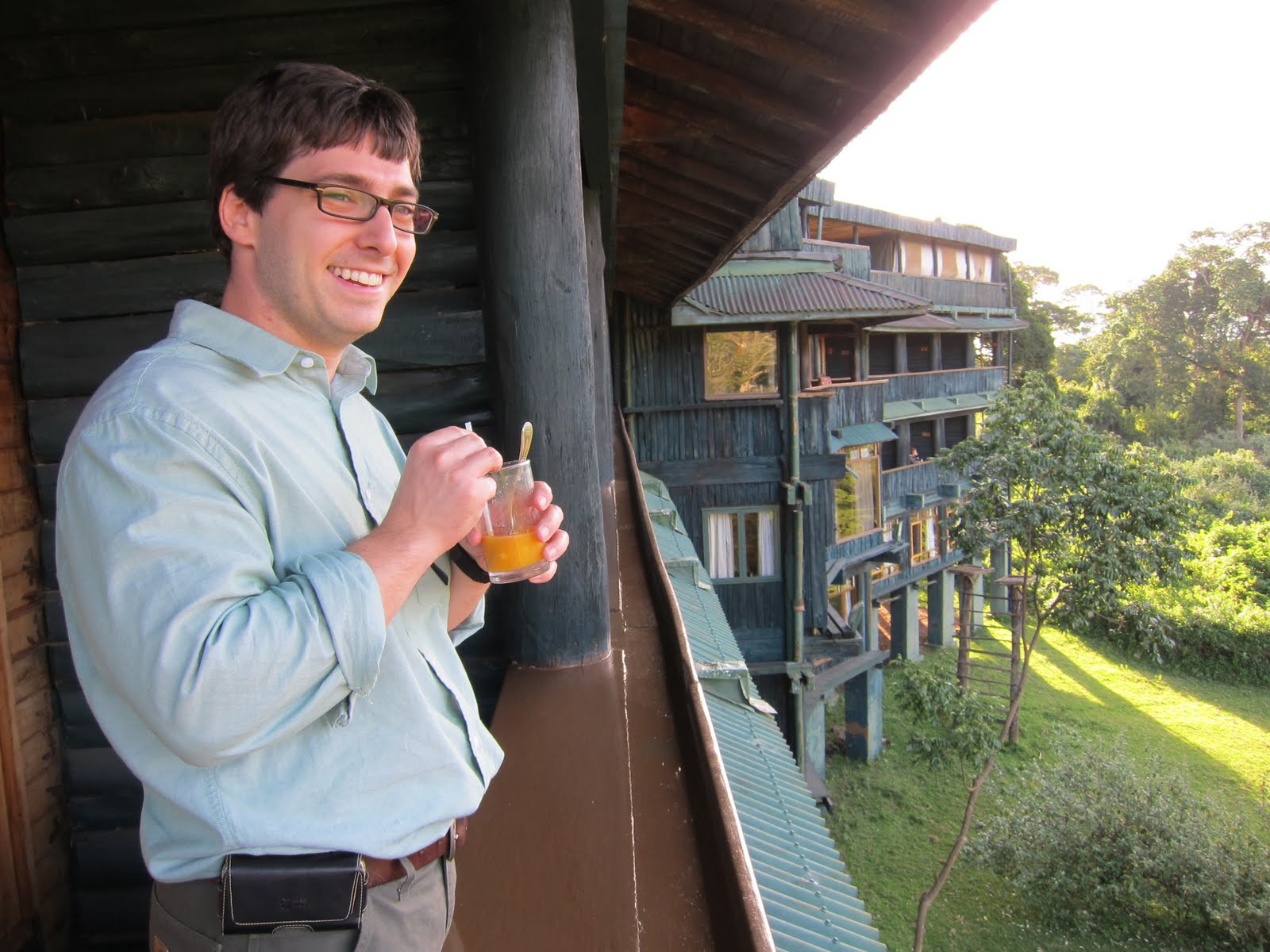
A view of the hotel from our room's balcony
We were encouraged to arrange a stay away from Tumutumu in order to get a broader view of the region.  Given the distance that we traveled it would be a shame not to see any wildlife.  So we arranged a weekend stay at Serena Mountain Lodge which is located in Mount Kenya National Park, only an hour's drive from Tumutumu. 

The hotel is built in a semi-circle around a natural water hole at the boundry of the bush and the rainforest ecosystems.  The structure is raised 15 feet from the ground to provide protection from the animals.  And did we see animals!  The watering hole attracts various wild animals native to the park. 

I think we underestimated this feature.  A zoo would be the closest thing to compare it too, but this doesn't quite fit.  At the lodge no animals are confined to cages and there is always the element of surprise!  What will wander out of the bush next?  Just another Cape Buffalo or and Elephant?  Believe me, the chance visit of a monkey on your room's balcony is better entertainment than TV. 

All the rooms face the watering hole with a balcony, a jungle gym for monkeys.  Our first words of advice upon arrival - “Always be sure to latch your door shut, the monkeys will make a mess if they get in your room”.  At 7200 ft elevation the temperature is always pleasant, cool and shaded to sit out and watch the animals.  Mount Kenya, only about 25 km from the hotel, the perfect backdrop.  The hotel guests take all their meals at the hotel, which are included in the price of the stay.  The location is so remote – at the end of a dead end road into the park - it's several miles drive to the nearest community or restaurant.

 Wildlife Tunnel
It was a great weekend.  Besides the delicious, 4 course meals, the comfortable bed and pillows, and a shower that is not too hot and not ice cold, we loved watching the animals!  We saw:  Cape Buffalo, Worthogs, Bushbuck, Egyptian Geese, Elephants, Baboons, Monkeys, Antelope, and Ground Pigs(?)...  A couple of the nice services of the hotel to help you see the animals:  they have an underground tunnel to allow you to get closer to the animals on their level.  And they will wake you up at night if an animal comes to the waterhole that you want to see – at dinner time they take your order.  “Please wake me up if a leopard or a hyiena is sighted.  No need to disturb me for a cape buffalo, they were around all day.”

If you're headed to Kenya and can't afford a safari we highly recommend this alternative.  It was so nice to learn more about the local habitat, wildlife, and environment.

Now, what I'm sure your all waiting for, a rundown of the animals we spotted:

Cape Buffalo
Baboons on the move...
Warthogs
Bushbucks (a female)
Male African Elephant
Monkeys (on our balcony!)
Elephants by the waterhole at night!