Monday, April 18, 2011

Nature Walk at the Mountain Lodge

On Saturday afternoon while at the lodge we went on a nature walk.  A guided tour through the very forest from which all the animals lived and traveled before gathering at the watering hole.  Does that seem a bit crazy?  Don't worry, no need to fear, an escort would follow with an assault rifle in case danger finds us.

We were scheduled to take the hike in the morning but it was delayed because the guard was unavailable.  He had be called away to free an elephant from a snare.  A snare is a trap set by poachers in the forest.  Illegal poaching for the ivory of elephant tusks is a big problem in the park and the enforcement officers are thinnly spread across the large area.

Our guide gave us lots of interesting educational facts about plants and animals and I'd like to share those that stuck with us.


Elephants are long lived in very close-knit familial groups.  They can live up to 70 years and eat as much as 200 kilos of foliage a day.  They feed 16 hours of each day.  By way of a poor digestive system they are responsible for sewing many of the seed of the forest in their depositions.  What I found really interesting about these tremendous creatures:  they mourn the loss of a family member and will actually gather debris to cover, or bury, their loved one.

Those cape buffalo are an irritable species.  They travel in groups and their aggression prevents them from being domesticated.  A lone male cape buffalo is one of the most dangerous animals to run into in the forest, they will attack unprovoked.  If you are so unlucky your only hope is to climb a tree.  If none is near, lie flat on the ground.  Hopefully he will just turn you over several times with his horns and stomp on you.  This is the only way people have survived a meeting.

The difference between the forest and the bush is that the bush has been deforested.  This is a huge problem in Kenya where many people gather wood for building fences and fire.  The old growth rainforest that we walked through has a beautiful clear, low understory.  By comparison the bush is thick and dense with woody shrubs.  It will take 600 years to return to a mature forest.

And I have to mention the Strangling Ficus.  This is a close relative of the beautiful banya trees we found in Hawaii.  But in this species seedlings find life in the crook of existing trees.  Then the roots form around the existing trees, using it as a crutch to reach the light quicker.  Eventually they completely devour the first tree and strangle it.  I think this is the same ficus you find consuming the temples of Angkor What in Cambodia.


Kenya is named for Mount Kenya, the country's second highest peak at 17000 ft.  (Mt. Kilamonjaro, south of Nairobi, is taller).  Mt. Kenya was an anomoly to the early western visitors because it sits nearly on the equator (off by 11 miles) and still retains snow and ice on its peak year round.  The name is derived from this contrast of black rock and white ice which many local tribes (each in their own language) called “ostretich tail”, which also has the same contrast.  The tribal word for this, per whichever of the eastern tribes the westerners were near, was something similar to Kenya.  42 distinct and seperate tribes, each with their own language and culture, lived in the boundries of present day Kenya.  Instead of choosing the name of one tribe to identify the region they chose the one landmark they all identify with, Mt. Kenya.

The hike concluded with tea time in the bush.  We came around the corner of the trail to find they had set out cups and saucers.  We sat on a log and enjoyed our afternoon tea.  I found it rather charming and picturesque.  Quite a fine hike.


Serena Mountain Lodge

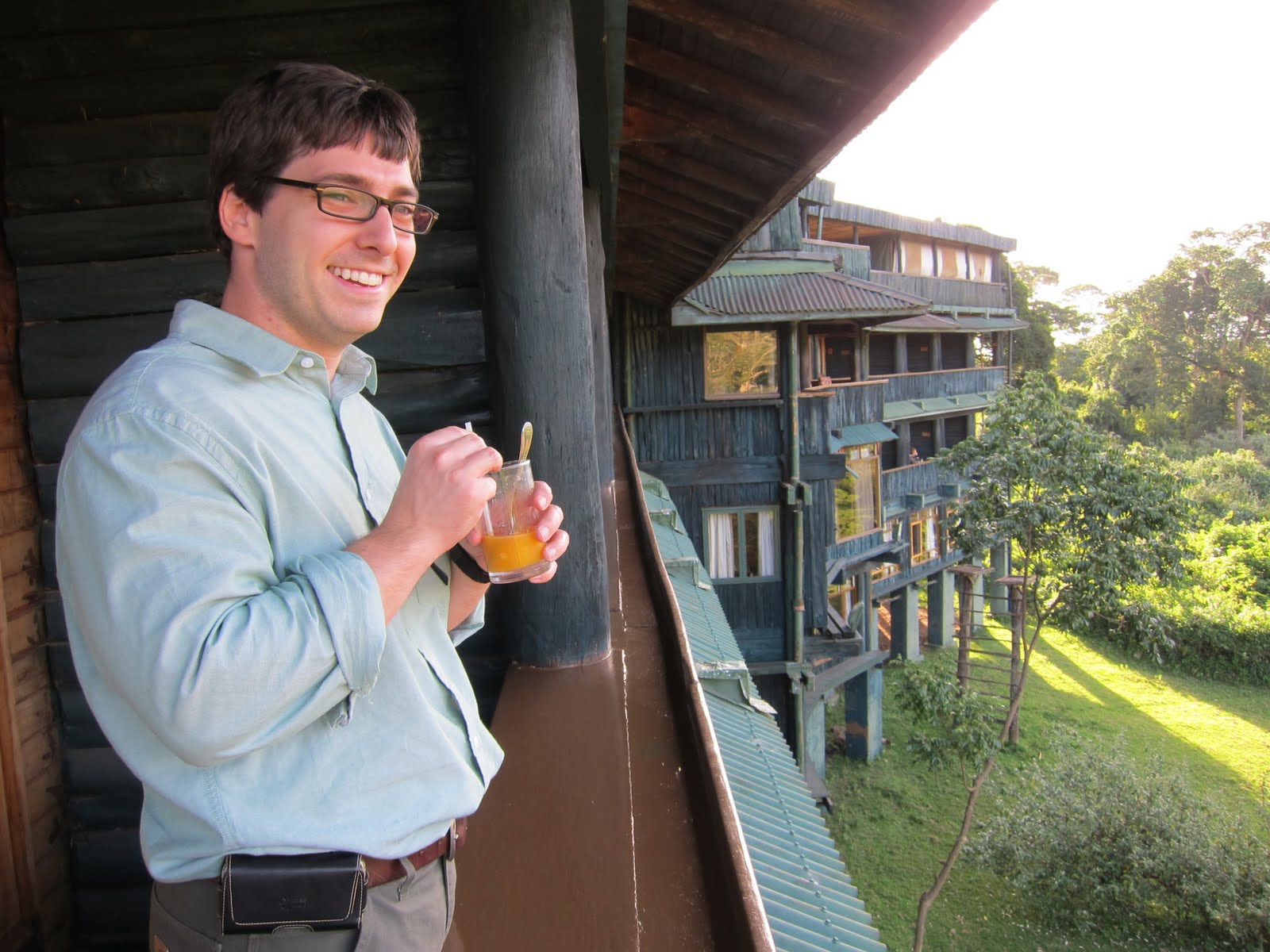
A view of the hotel from our room's balcony
We were encouraged to arrange a stay away from Tumutumu in order to get a broader view of the region.  Given the distance that we traveled it would be a shame not to see any wildlife.  So we arranged a weekend stay at Serena Mountain Lodge which is located in Mount Kenya National Park, only an hour's drive from Tumutumu. 

The hotel is built in a semi-circle around a natural water hole at the boundry of the bush and the rainforest ecosystems.  The structure is raised 15 feet from the ground to provide protection from the animals.  And did we see animals!  The watering hole attracts various wild animals native to the park. 

I think we underestimated this feature.  A zoo would be the closest thing to compare it too, but this doesn't quite fit.  At the lodge no animals are confined to cages and there is always the element of surprise!  What will wander out of the bush next?  Just another Cape Buffalo or and Elephant?  Believe me, the chance visit of a monkey on your room's balcony is better entertainment than TV. 

All the rooms face the watering hole with a balcony, a jungle gym for monkeys.  Our first words of advice upon arrival - “Always be sure to latch your door shut, the monkeys will make a mess if they get in your room”.  At 7200 ft elevation the temperature is always pleasant, cool and shaded to sit out and watch the animals.  Mount Kenya, only about 25 km from the hotel, the perfect backdrop.  The hotel guests take all their meals at the hotel, which are included in the price of the stay.  The location is so remote – at the end of a dead end road into the park - it's several miles drive to the nearest community or restaurant.

 Wildlife Tunnel
It was a great weekend.  Besides the delicious, 4 course meals, the comfortable bed and pillows, and a shower that is not too hot and not ice cold, we loved watching the animals!  We saw:  Cape Buffalo, Worthogs, Bushbuck, Egyptian Geese, Elephants, Baboons, Monkeys, Antelope, and Ground Pigs(?)...  A couple of the nice services of the hotel to help you see the animals:  they have an underground tunnel to allow you to get closer to the animals on their level.  And they will wake you up at night if an animal comes to the waterhole that you want to see – at dinner time they take your order.  “Please wake me up if a leopard or a hyiena is sighted.  No need to disturb me for a cape buffalo, they were around all day.”

If you're headed to Kenya and can't afford a safari we highly recommend this alternative.  It was so nice to learn more about the local habitat, wildlife, and environment.

Now, what I'm sure your all waiting for, a rundown of the animals we spotted:

Cape Buffalo
Baboons on the move...
Warthogs
Bushbucks (a female)
Male African Elephant
Monkeys (on our balcony!)
Elephants by the waterhole at night!


Sunday, April 17, 2011

What We're Reading

I always like to pick up a good book before we get on an airplane.  But this venture especially has allowed for more reading besides just the time in transport.  When traveling to a foreign country I especially like to learn something about the history and culture we are to be immersed in. 

So, how to find writings from and about Kenyans?  I began this investigation by refering to the 'Literature' entry in the Lonely Planet guide to Kenya at Richland Public Library.  African literature often runs in to the problem of lanuage.  Some prefer to write in their native tribal tounge.  Others find it necessary to write in English in order to increase readership.  Several authors were mentioned in Lonely Planet, some with Kikuyu publications, some in Swahili, some in English, some whose work had be translated from Kikuyu to English... availablilty of many works is often limited...

A search of the authors in RCPL system produced only 2 hits.  One was a novel written for children, a 150 page tail.  It is quite a moving story about a Kenyan boy who befriends the grandson of a British expat, all set around the time of the Mau Mau rebellion.  I really enjoyed this simple story and can't remember the name of the book!  Sorry!

The second hit was “Gods and Soliders, The Penguin Anthology of Contemporary African Writing”.  This is a book of short stories and articles, both published and unpublished, written within the last 10 years by Africans.  The entries are organized by regions.  Some are small works of fiction, others are political commentary, some discuss issues of African identity and voice in literature.  After language, the problem of grouping a collection of writings under the title 'African' is that each country is so different.  Many share similar stories of western colonization followed by a struggle for independence.  But the details of each story are so complex relative to their political makeup, tribes, geography, and culture.  Many very intriguing works from a contininent searching for a voice.  However, it did not give me the insight into Kenya specifically that I was searching for...

A book that has been suggested to me by a fellow Tumutumu volunteer is “Britian's Gulag: The Brutal End of Empire in Kenya” by Caroline Elkins.  The book is a detailed account of the MauMau uprising in rejection of British colonialism, gathered from interviews of both Kenyans and Brits.  The book is huge and it sounds a bit dry and dense for me, but perhaps a few chapters would shed light on that time in Kenya.

As previously mentioned, we consulted our friend Sarah Cooper Searight on an appropriate reference for ministry she suggested Henri Nouwen's “Gracias! A Latin American Journal”.  Though the culture of this book is Catholic and the local is South America, many of the issues of poverty transfer well to our setting in rural Kenya.  We hesitate to use the word “mission” to describe our trip... it can have such negative connotations.  But the tone of this journal and his approach to ministry is alligned with our philosophy.
'“It is the change from selling pearls to hunting for treasure.”  Indeed, not too long ago the task was seen as selling the pearls of good news to the poor and ignorant people.  Now a radically new perspective dominates... to search with the poor for the treasure hidden in the ground on which they stand.  It is the shift from spiritual colonialism to solidarity in servanthood...'
So many exerpts speak to us and this place.  We have been reading it aloud daily during our time of devotion.  We highly recommend it!

Matthew has been brushing up on his knowledge of tropical medicine by referencing “Principles of Medicine in Africa”, borrowed from Dr. Daniel Everett, a physician from the states also staying at our guest house.  He says it has a lot of infectious disease information and some about more common problems such as diabetes and heart failure. It's a little out of date, but it's nice to have something to reference for the diseases that aren't often seen in the US.

Geo-tagging

I'd like to take a brief moment and talk about my latest obsession in photography. While Christina works on perfecting her framing, white balance, contrast, and composition my concern is different- mainly where is the picture being taken. While I was travelling recently, I found that my phone has the ability to Geo-tag. For those of you who are not familiar with this, basically some cameras and phones have the ability to attach GPS coordinates of longitude and latitude to the picture being taken.

I realize this may not be that important to most people. I also realize that most people aren't as nerdy as I am. That's OK. We can't all be perfect. To me this has been like putting a digital push-pin on the map of places I've visited. Instead of finding an interesting picture, I often find myself thinking, “Do I have a picture that I've taken in Chicago? No? Well, let me take a random picture in the airport so that it'll show up on my map.”
Right now, I don't have any data access on my phone. I looked into the cost and basically it's about $15 US per kilobyte. For me to use my phone as I normally would this month, it would cost me in the ballpark of $1,500US. So I'm leaving the phone off. However, it still picks up the GPS signal. So I guess I can check Africa off the list. Maybe we'll get to Australia some day...

London Geo-Tag

Case Presentation 1

Case 1
25 yo female with no PMH presents with convulsions. She has been in her usual state of health until the day of presentation. She has spent the day travelling on a bus from the Rift Valley to Karatina. She states she packed her own food and did not eat anything offered to her on the bus. On arrival to Karatina she had a convulsion as described by the fellow travellers. Patient was admitted and was witnessed in hospital to have several more convulsions that started with facial spasms and generalized to tonic clonic convulsions. The convulsion lasted for "a while" and was broken by giving 30mg of diazapam slow IV push. Patient returned to baseline and was noted to have brusing on her tongue.

ROS: + for HA on and off for the past month, relieved with paracetomal. No HOB, no blurriness of vision. Otherwise negative.
PMH:-
FMH:-for epilepsy
Social: Denies EtOH, tobacco, drug use.
Medications :none
Allergies: NFDA

PE: T36.7 P80 R20 BP: 140/60
General: Well developed African female, NAD
Head: ATNC
Eyes: Conjunctiva pink, sclera anicteric, PERRL, EOMI
Neck: No menignismus, Fullness of R thyroid with no appreciable nodules.
CV: RRR, no MRG; peripheral pulses present, symetric; cap refill <2sec
Resp:LCTAB
GI: AB S/NT/ND/BS+
MS: FROM
Skin: No rashes/bruises/lesions
NEURO: CNII-XII intact; sensation intact B/L; strength is 5/5 throughout; no dysmetria; abulation without difficulty; A&Ox3

A/P: 25yo with new onset convulsions
Obtain full Hemogram, UEC's and Pregnancy Test. Order CT head for masses/bleeding. Admit for observation. Diazapam PRN for seizures, PCM for headaches. Re-eval in AM.

Discussion:
This was an interesting case for me, not because of the medical aspects itself, but it brings up some important social issues. As is probably evident in the case, Kenyan's don't really use the term seizures, but convulsions. It's really a minor difference, but there are many of these language problems I've run into during rounds. They tend to call congestive heart failure (CHF) congestive cardiac failure (CCF). Fevers are hotness of body (HOB). A basic metabolic profile (BMP) is equivalent to a urea, electrolytes, and creatinine (UEC). They are very subtle differnece and it's not difficult to adapt, but they use abbreviations as commonly as we do and I feel I slow down discussion some by asking what each of these mean.
As mentioned above, the patient had an enlarged thyriod that was picked up on physical exam. After more discussion with the patient we found out that it was evaluated several years ago at an outside hospital. She was told then that she needed her thyroid taken out. This I actually seemed very familiar to me. I can't count the times that patients have been told they needed a procedure, a scan, an xray, or just follow-up and haven't- either because they were scared or just couldn't afford it. Strangely, I felt reassured that somehow all people are alike.

The patient did very well and had no more seizures throughout her hospital stay. However, the CT was never performed for 2 reasons. One was that she was afraid of what the scan might due to her. The other was that she and her family could not afford the test. While many of the service Tumutumu provides are cost-reduced (such as medications, laboratory tests, and meals) any of the tests obtained outside of the hospital (such as CT's, MRI's, Ultrasounds, and EGD's) are paid for in advance by the patient. Ultrasounds cost about 2,000 shillings (about $25 US) and CT's cost about 10,000 ($126). Although that doesn't sound like much but the average salary in Kenya is $730 US. Often patients have to call family and friends to help come up with the money. Often this can delay the test (and often diagnosis) by days.
Our patient ultimately decided that she did not want the test and wanted to be discharged home. This comes up alot here and seems to be to be a real contrast to how we practice in the US. Here in Kenya, if patients want to stay, the doctors are not really apt to forcing them out. If they want to go, there is no discussion on leaving against medical advice and documenting risks as we would in the US, patients are just discharged. That's not to say that the patients aren't informed, it's just that there isn't much malpractice out here to worry about.

I really hope that the patient does well, and hope that she follows up in clinic. I think many patients are lost to follow-up because of distance, time, and cost. I guess like many things out here in Kenya, it's out of our hands.

Friday, April 15, 2011

The Pharmacy

One of the questions I was frequently met with as I prepared for this trip, and a question I liked to avoid, was, “So,  Matthew will be seeing patients in Kenya, and what are you going to do?”.  It distressed me a little.  I was assured that I was needed and that I would be put to work but my exact function was unclear.  I had this fear, with such a loosely defined role, that I would be only superficially needed, or that I would have time on my hands.  I've had jobs like that and nothing is worse than watching the clock, waiting for lunch or the end of the day.

This is why I have been so pleased with my position helping out at the pharmacy.  One major pharmacy serves both the out-patient needs and the wards.  The unit is always busy and I have always felt needed.  My first afternoon was spent learning the system and becoming familiar with the drugs – the commonly used trade names vs. the generic names.  All of which are a little different than what is used in the US.  My tasks range from restocking shelves to filling prescriptions. 

Most often I account for which medications and how many are distributed to which patients in the computer system.  The hospital uses a hybrid system of processing drug requests.  Most orders are handwritten and logged in the computer.  The pharmacy then reviews and verifies the orders and reconciles any discrepancies.  It is a somewhat tedious task that often reminds me of creating a plant schedule where size, number, common name and scientific names are specified, a common task during my time as a landscape architect.

I am most grateful for the people I work with in the pharmacy.  Everyone is unfailingly kind and patient.  They are always interested in teaching and never bothered by my endless questions.  Everyone who comes to the counter, patients and staff, is interested in the white girl, often greeting me with a smile and welcome.  It is truly a reflection of their culture that this has been such an easy transition.  After a few days here I have begun to feel comfortable (with my handmade cheatsheet of drugs), familiar enough with the rhythm of the day that I am able to anticipate the next task. 

The one regret is that I don't deal much with patients.  The mystery of this place is that three different languages are commonly spoken: Kikuyu (the tribal language wildly spoken in the central highlands), Swahili, and English.  And then there is another variation that is a hybrid of Swahili and English.  The pharmacist (there are 2 working in overlapping shifts) exclusively interact with the patients and staff in Kikuyu.  This leaves me in the dark.  They make jokes that I am not included in (maybe they are about me!).  But also, comments from staff and their exchange with physicians and nurses are always beyond my comprehension.  

An unexpected benefit of this position is that finally Matthew and I are working in the same world.  I know this sounds silly, but the endless talk about his work is now a little more of our common work.  Though much of it still is tedious and goes without comment from me it is nice that we are vested in the same interest of patient care and a well run hospital system.


Thursday, April 14, 2011

Retreat

Childlike.  Lack of Control.  All is new a different.  Routines and schedules are forgotten.  We are here empty, starting anew. 

What was initally a frustration has become quite liberating.  All the daily concerns and distractions of home are absent.  No cell phones, no internet, no TV, no vehicles. 

Think about that!!!  This is what I've learned:
  • A phone call is not required everytime my husband is late or my hands are idle.  He'll show up.  I can be patient.  
  • I only really require 10 minutes on the internet once a day to check my email and cut and paste a blog entry (written the night before).
  • A book can be just as entertaining as the television.  Chances are it's a lot more educational too. 
  • Walking is virtuous.  The fresh air, a stunning landscape, and the sounds of the environment are worth the extra time and effort.  There are never traffic headaches on our dirt path!
    

All we are left with is quiet.  And it is so refreshing.  Matthew and I, who I think have a strong relationship, have spent more time talking and listening to each other.  Problemsolving.  Creating.  Sympathizing.  Supporting.  We have really made an effort to make time to communicate.  To discuss issues and life in a way that our routines at home don't allow.  Time to share and time to pray.

In this way it has become a retreat for us.  A way of recentering our life, refoucusing our energies, a way of discerning what is really important and where we are being lead.  It is a great way to begin this next phase of our life... as we leave the great community we've built in Columbia... as we become infants again in California.