Sunday, April 24, 2011

Case Presentation 3

(If you are squeemish, please do not click the pictures below.)

Patient is a 47yo male with no past medical history who presents with one month history of rash. He denies any "hotness of body," nausea, vomiting, or other symptoms. He states the rash started on his hands and feet and have now spread to the rest of his body including his face and scalp. The rash is itching and sometimes painful. He has come in now because his feet have started cracking and weeping. The patient's vital signs are within normal limits and he denies any other systemic complaints. His DTC was negative as was his VDRL. His hemogram was normal. Please see pictures below at your own risk.


Discussion:
This is a case of Norwegin Scabies. When I first saw it, I thought about syphilis, but with the negative VDRL and the lack of other symptoms (such as a preceeding chancre), we took that off the list. This is pretty much the worest case of scabies I've ever seen. He also has a bacterial superinfection on his feet too. We wanted to start him on Ivermectin and dicloxicillin, but unfortunately the pharmacy doesn't carry Ivermectin. In those cases, we write a prescription and the family members have to pick the medication up at an outside pharmacy. To my knowledge, we are still waiting for the Ivermectin...

Another point this brings up is in infection control. There are very few measures taken on the wards to keep patients from infecting each other. The doctors all walk around with individual hand sanitizer, but I'm pretty sure the nurses wash their hands a few times a day (mostly before eating). There are some gloves available, but they are often difficult to find, and each glove used are charged to the patient. So our patient is probably sharing his scabies with the rest of the ward.

It makes me itch just thinking about it.

Mobile Clinic

Gatithi Medical Clinic

This week, both Christina and I were able to help out with the HIV mobile clinic. Basically it is like the Comprehensive Care Clinic that has been loaded into a land rover. On the day we helped out we stopped at Gatithi, a small town about 30 minutes outside of Tumutumu. There is a small clinic there that is still under construction. There we unpacked large boxes of medications, patient files, equipment, and other various paperwork. We even took our own table and chairs.


The idea of the mobile clinic is to create a satellite of the CCC that is more accessible to the patient population. Even though Tumutumu is only a 30 minute drive, many people do not have cars and do not have the money to pay for the matatu to the hospital. Without this service, many of the people would be non-compliant with their medication regiment, an act that would not only be dangerous for them, but also for the rest of the community.

The people walk from their homes to the clinic and line up hours before the team arrives. The patients check in with a nurse who weighs them, takes their vital signs, counts their pills, and provides teaching on their medications. Education is really stressed and patients are expected to know what medications they are taking and at what times. The nursing staff is fairly aggressive and will chastise those patients who fail the quiz.

From there, the patients see the doctor and describe any symptoms they might be having. Mostly the patients were complaint free, but occasionally we would treat a simple upper respiratory or skin infection. There were also a variety of muscle and joint complaints although no seriously ill patients. After seeing the physician, the patient goes to the mobile pharmacy and picks up their HIV medication and any other antibiotic or pain medication prescribed. This is where Christina worked and it kept her pretty busy. The pharmacist provides further counseling and education on their medications. Again, all the anti-retroviral medications, multivitamins, and antibiotics are free to the patients and provided by USAID.


The mobile clinic is a great addition to the CCC and an invaluable resource to the patients it serves. We saw about 50 patients, many of which were either pediatric or elderly and would not have the time or the energy to get their badly needed medication. It was also a great opportunity for Christina and me to see the patients out in the community and to see the patients in their home environment. The poverty was sobering. There were fewer nice suits and dresses, which you see a lot of at Tumutumu, and more tattered, second-hand clothing (one 45 year old gentleman had an "Ohio State Grandma" sweatshirt). It was a chance to reach out to the community at large and witness their daily struggle first hand.

Matthew and a Medical Officer evaluating a patient.

Patients waiting to be seen.
Patient signing a compliance contract stating that he understands the medications being prescribed and will take the medications.

Friday, April 22, 2011

Kenyan Observations

Just a couple of cultural differences worth mentioning:

The dress code always errs on the side of formal. If in dought, dress up. Any occasion that brings you to the hospital, whether a visitor or patient, is reason to dress nice. Even if it is an ill-fitting, third hand, dusty sports coat it is dressy and should be worn. I think everyone is confused that Matthew wears scrubs daily (though he was told to bring them). Scrubs here are only worn in the surgery theater by those preforming the procedure. They change out of those scrubs, into their suits and ties, before walking back through the hospital. Everyone from nurses to bus drivers to doctors are better dressed than Matthew and I every day.

A couple of my favorite questions asked while I've been here: “How many tribes are in the United States?”. Its really an interesting question... yes, there are some unique cultures but I don't think it compares with their tribal identity. They are always shocked that I only speak one language and that that is common in the US.

“How much did your husband pay for you when you were married?”. They Kenyans raise a combination of money, crops, and livestock to pay for their bride. They will enter into a contract with a family and spend time raising the money, which is their engagement period. Depending on how beautiful and wealthy and well educated the girl this sum can be as high as $3000 US, which is quite a lot for their standards.

Food: We eat very well at the guest house. Breakfast is pretty international, toast, cereal, boiled eggs and sausage. Lunch and Dinner always brings more food than is necessary. Soup (usually a simple broth), two starches (usually a light pasta dish and potatoes), two meats (chopped beef in a gravy and either chicken or fish), and two vegetables (peas and carrots and a cabbage slaw). Fresh fruit for dessert. No cheese or yougarts. There is warm milk for the cereal at breakfast and in the tea.


Tea is at 10:30 and 4:00. Take your tea, take your time, enjoy it, do not be stressed about all the other tasks you must complete. Its amazing how that instantly becomes trivial and takes a back seat to the matter at hand: tea. Matthew gets frustrated that this is such a priority with nurses serving patients... tea before medications? Really?

Though the finest coffee in the world is grown and roasted in this region of Kenya you won't find it is served among the people. It's far too expensive. Instant is the only option if you prefer coffee. Matthew is surviving quite well. And sleeping much more than normal.

There is an interesting paradox between cleanliness and aesthetics. Everything is cleaned emphatically. Floors are mopped often, sidewalks are scrubbed. Much effort is devoted to keeping the hospital and any general living space clean. However, I can't say the same pride is always taken in construction of the facilities. I don't think a general design aesthetic is ever considered and the craftmanship of building projects is often poor. Paint jobs often reveal huge drips, linoleum tiles are askew with the wall and don't match up (often several un-coordinated tile patterns are used), concrete is poured inconsistantly and unlevel. Resources are obviously available, they just aren't always allocated and put together well. Regardless everything is well worn and used, and mopped and scrubbed.

The Presbyterian Church has a strong hold over the region. It seems 2 of every 3 civic institutions we pass along the roadway are PCEA institutions (Presbyterian Church of East Africa). Chuches, schools, hospitals, orphanages... And they seem to be well used and populated institutions.

Though it rarely gets below 65 degrees here this is still their coolest season which means the winter clothes come out. Kids run around in parkas. Everyone wears sweaters and knit hats. It's crazy.

Everyone here has a cell phone. Unfortunately this culture has not adopted a cell phone etiquette. No one puts their phone on silent. Doctors, students, nurses and patients will answer their phone if it rings, regardless of what they are doing at the time. Very few smart phones.

Yes, our guest house has running water and power. But this is really a temporal condition. The power blinks or simply shuts down for 'rationing' at any time (the hospital has a deisel run generator which is often used). And I haven't figured out why water has become a problem... I see water in the tank behind the guest house... but we have been without water for a few days now. Sometimes everything is working great but often one thing or the other is out of order. An emergency bucket of water is always wise for flushing the toilet or taking a sponge bath.

And my final observation... this is the first place I've ever been where no one has made a comment about my hair.  No one has asked to touch it or inquired if it's naturally curly... nothing.  I think maybe it far too common here to be considered special.

Wednesday, April 20, 2011

Comprehensive Care Clinic

Today I had the opportunity to help out at the Comprehensive Care Clinic (CCC). This clinic serves individuals with HIV and Tuberculosis. Mainly, this is clinic provides free medications to those with HIV and TB and follows up on routine concerns such as CD4 counts and treatment failures. As part of the CCC, community workers even visit the homes of patients to ensure medication compliance. The workers often go on daily runs and has a fleet of bicycles, motorcycles, and a vans to accomplish this task. Fortunately most people are very reliable and appreciative of the care that they receive.

The clinic sees an average of about 50 people a day. Most of the visits are very short and consists of checking vitals, refilling medications, and occassionally checking CD4. However, a few patients do require additional testing to evaluate for pneumonia or other infections. These tests and their medications are all provided at no additional costs to the patient and is funded by USAID (United States Agency for  International Development).

Clinicians will take bicycles and motorbikes into the community to find non-compliant patients. 
It was a good chance to see many different members of the community. Even some of the Tumutumu hospital employees frequent this clinic. The patients were all very friendly and grateful to be seen. Often times working in the emergency department is a thankless job... it is nice to be able to provide care to patrons who truly appreciate it.  

Case Presentation 2

Patient is a 57 yo who has ISS and TB who presented with confusion and decreased intake. The family states the patient was started on medication for the above diagnoses about 2 weeks ago. Patient has become more and more confused and has not said anything in the last 24 hours. He seems to have "hotness of body" and hasn't had anything to eat or drink in 2 days.

When we evaluated the patient, he was not febrile but was minimally responsive to pain and verbal stimuli. He was tachycardic and appeared very dehydrated. He was found to be tachypneic and his oxygen saturation was 92%. The patient was given IV fluids and started on Co-tramazole, Ceftriaxone, and Acyclovir. ECG was performed to evaluate his tachycardia. Complete hemogram, UEC, and chest xray were ordered and a lumbar puncture was performed.

Discussion:

There are a few points that I would like to discuss about this patient. The first is the fact that the patient is "ISS." This stands for "immuno suppression syndrome". There is such a stigma here in Kenya against HIV that even doctors can't discuss this openly with patients. It goes so far that you cannot order a rapid HIV test. Physicians instead order a DTC-diagnostic testing and counciling. Even the HIV clinic has a euphamistic name- the Comprehensive Care Clinic. Apparently if it was called the HIV clinic no one would come. That's not to say that we don't have a stigma in South Carolina as well, but I feel that in SC we can speak more openly about the subject.

This is one of the sicker patients that I have seen here. In the emergency department he's what we would call an easy admission. With the limited resources, it makes it very difficult to treat the acutely ill. We were able to obtain an EKG, but this took several hours. The machine is not very portable and is almost on par with putting the patient's hands and feet into buckets of water. Acutally there are clamps that are attached to the limbs, and the precordial leads are held in place by bulb-suction devices. The leads are printed out one at a time and the clinical officer has to cut them all out and tape them onto another sheet of paper to place in the chart. The process takes anywhere from 30-45 minutes from start to finish not including the cutting out (and you thought it took awhile to get one at Richland).

Oxygen is often difficult to get onto the patient and tanks have to be wheeled to the bedside. This takes a lot longer than you would really want and sometimes makes me nervous, but often there just isn't a tank available. These tanks are not very portable which means if a patient is needs O2 they can't go anywhere. Even getting a simple chest xray is impossible. Forget a stat CT- that requires raising funds and a day of travel. Sometimes I forget how easily these diagnostic studies are obtained at home.

The patient is currently being treated for TB and I asked about placing him in isolation. Basically there is no isolation here. The doctors practice on the theory that it is basically endemic to Kenya. "Everybody has TB here, just not everyone shows it," is what the intern told me. To which I replied, "I don't have TB!" She simply shrugged and told me not to breath too deeply.

We were able to obtain CSF and it was actually negative. I was able to walk the clinical officer through his first successful LP (or more likely he succeeded despite my misdirection). The lumbar puncture kits are very simplistic and they cannot get an opening pressure or perform cultures. However, they can obtain cryptoccal antigens studies and these were negative as well. Still, we threw everything but the kitchen sink at this guy. In addition to antibiotics, patient received IVF and tea through NG tube. Apparently it is customary to place an NG twice a day to make sure the patients get tea time.

Over the last few days, the patient has done very well. He is now off oxygen and has vastly improved, although still confused. We still don't know the underlying eitiology of his illness although the current theory is either sepsis (unknown sources) vs IRIS- immun-reconstitution syndrome. I am glad to see him improve everyday even if he has no idea who I am.


Monday, April 18, 2011

Nature Walk at the Mountain Lodge

On Saturday afternoon while at the lodge we went on a nature walk.  A guided tour through the very forest from which all the animals lived and traveled before gathering at the watering hole.  Does that seem a bit crazy?  Don't worry, no need to fear, an escort would follow with an assault rifle in case danger finds us.

We were scheduled to take the hike in the morning but it was delayed because the guard was unavailable.  He had be called away to free an elephant from a snare.  A snare is a trap set by poachers in the forest.  Illegal poaching for the ivory of elephant tusks is a big problem in the park and the enforcement officers are thinnly spread across the large area.

Our guide gave us lots of interesting educational facts about plants and animals and I'd like to share those that stuck with us.


Elephants are long lived in very close-knit familial groups.  They can live up to 70 years and eat as much as 200 kilos of foliage a day.  They feed 16 hours of each day.  By way of a poor digestive system they are responsible for sewing many of the seed of the forest in their depositions.  What I found really interesting about these tremendous creatures:  they mourn the loss of a family member and will actually gather debris to cover, or bury, their loved one.

Those cape buffalo are an irritable species.  They travel in groups and their aggression prevents them from being domesticated.  A lone male cape buffalo is one of the most dangerous animals to run into in the forest, they will attack unprovoked.  If you are so unlucky your only hope is to climb a tree.  If none is near, lie flat on the ground.  Hopefully he will just turn you over several times with his horns and stomp on you.  This is the only way people have survived a meeting.

The difference between the forest and the bush is that the bush has been deforested.  This is a huge problem in Kenya where many people gather wood for building fences and fire.  The old growth rainforest that we walked through has a beautiful clear, low understory.  By comparison the bush is thick and dense with woody shrubs.  It will take 600 years to return to a mature forest.

And I have to mention the Strangling Ficus.  This is a close relative of the beautiful banya trees we found in Hawaii.  But in this species seedlings find life in the crook of existing trees.  Then the roots form around the existing trees, using it as a crutch to reach the light quicker.  Eventually they completely devour the first tree and strangle it.  I think this is the same ficus you find consuming the temples of Angkor What in Cambodia.


Kenya is named for Mount Kenya, the country's second highest peak at 17000 ft.  (Mt. Kilamonjaro, south of Nairobi, is taller).  Mt. Kenya was an anomoly to the early western visitors because it sits nearly on the equator (off by 11 miles) and still retains snow and ice on its peak year round.  The name is derived from this contrast of black rock and white ice which many local tribes (each in their own language) called “ostretich tail”, which also has the same contrast.  The tribal word for this, per whichever of the eastern tribes the westerners were near, was something similar to Kenya.  42 distinct and seperate tribes, each with their own language and culture, lived in the boundries of present day Kenya.  Instead of choosing the name of one tribe to identify the region they chose the one landmark they all identify with, Mt. Kenya.

The hike concluded with tea time in the bush.  We came around the corner of the trail to find they had set out cups and saucers.  We sat on a log and enjoyed our afternoon tea.  I found it rather charming and picturesque.  Quite a fine hike.


Serena Mountain Lodge

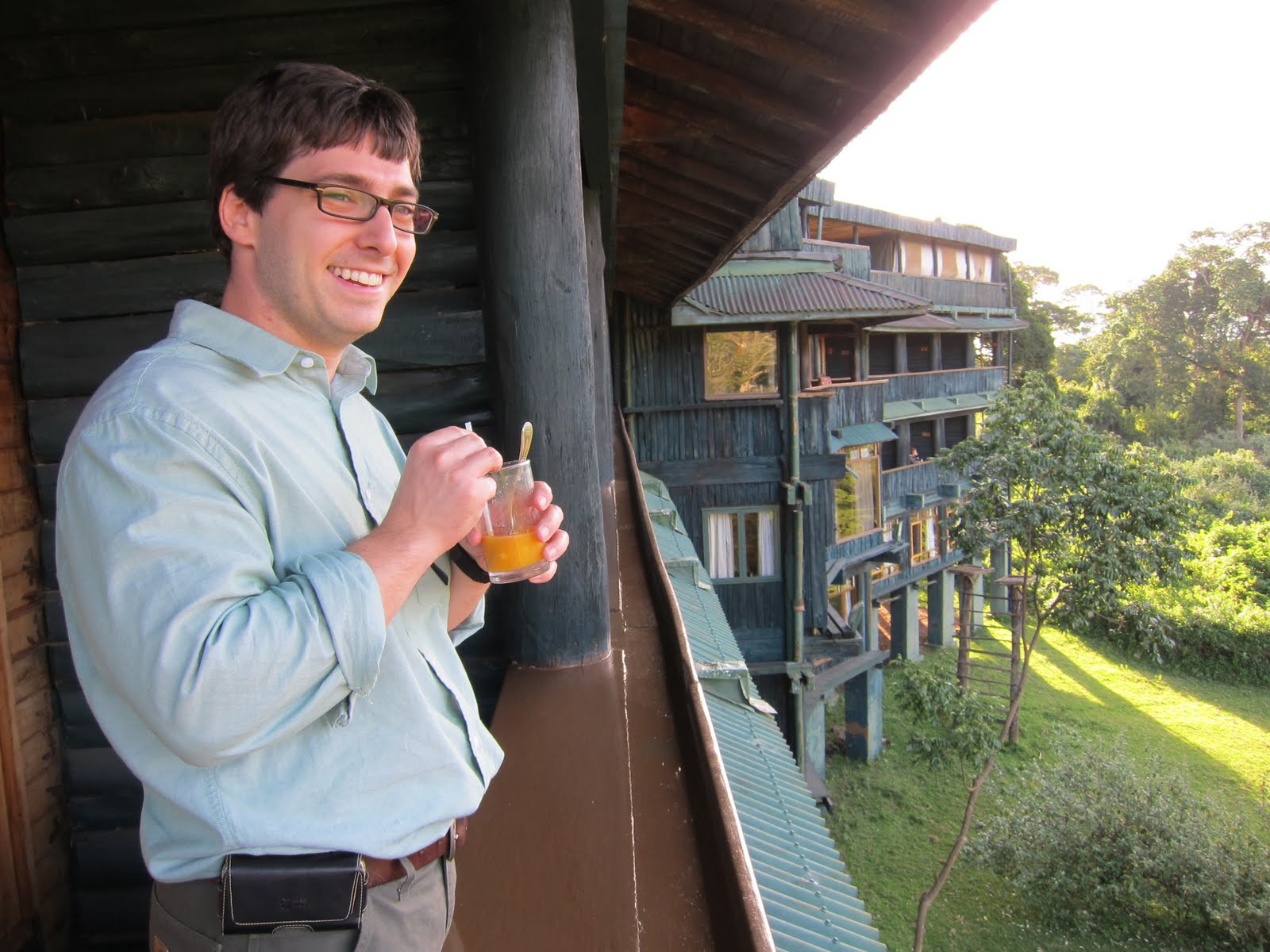
A view of the hotel from our room's balcony
We were encouraged to arrange a stay away from Tumutumu in order to get a broader view of the region.  Given the distance that we traveled it would be a shame not to see any wildlife.  So we arranged a weekend stay at Serena Mountain Lodge which is located in Mount Kenya National Park, only an hour's drive from Tumutumu. 

The hotel is built in a semi-circle around a natural water hole at the boundry of the bush and the rainforest ecosystems.  The structure is raised 15 feet from the ground to provide protection from the animals.  And did we see animals!  The watering hole attracts various wild animals native to the park. 

I think we underestimated this feature.  A zoo would be the closest thing to compare it too, but this doesn't quite fit.  At the lodge no animals are confined to cages and there is always the element of surprise!  What will wander out of the bush next?  Just another Cape Buffalo or and Elephant?  Believe me, the chance visit of a monkey on your room's balcony is better entertainment than TV. 

All the rooms face the watering hole with a balcony, a jungle gym for monkeys.  Our first words of advice upon arrival - “Always be sure to latch your door shut, the monkeys will make a mess if they get in your room”.  At 7200 ft elevation the temperature is always pleasant, cool and shaded to sit out and watch the animals.  Mount Kenya, only about 25 km from the hotel, the perfect backdrop.  The hotel guests take all their meals at the hotel, which are included in the price of the stay.  The location is so remote – at the end of a dead end road into the park - it's several miles drive to the nearest community or restaurant.

 Wildlife Tunnel
It was a great weekend.  Besides the delicious, 4 course meals, the comfortable bed and pillows, and a shower that is not too hot and not ice cold, we loved watching the animals!  We saw:  Cape Buffalo, Worthogs, Bushbuck, Egyptian Geese, Elephants, Baboons, Monkeys, Antelope, and Ground Pigs(?)...  A couple of the nice services of the hotel to help you see the animals:  they have an underground tunnel to allow you to get closer to the animals on their level.  And they will wake you up at night if an animal comes to the waterhole that you want to see – at dinner time they take your order.  “Please wake me up if a leopard or a hyiena is sighted.  No need to disturb me for a cape buffalo, they were around all day.”

If you're headed to Kenya and can't afford a safari we highly recommend this alternative.  It was so nice to learn more about the local habitat, wildlife, and environment.

Now, what I'm sure your all waiting for, a rundown of the animals we spotted:

Cape Buffalo
Baboons on the move...
Warthogs
Bushbucks (a female)
Male African Elephant
Monkeys (on our balcony!)
Elephants by the waterhole at night!